
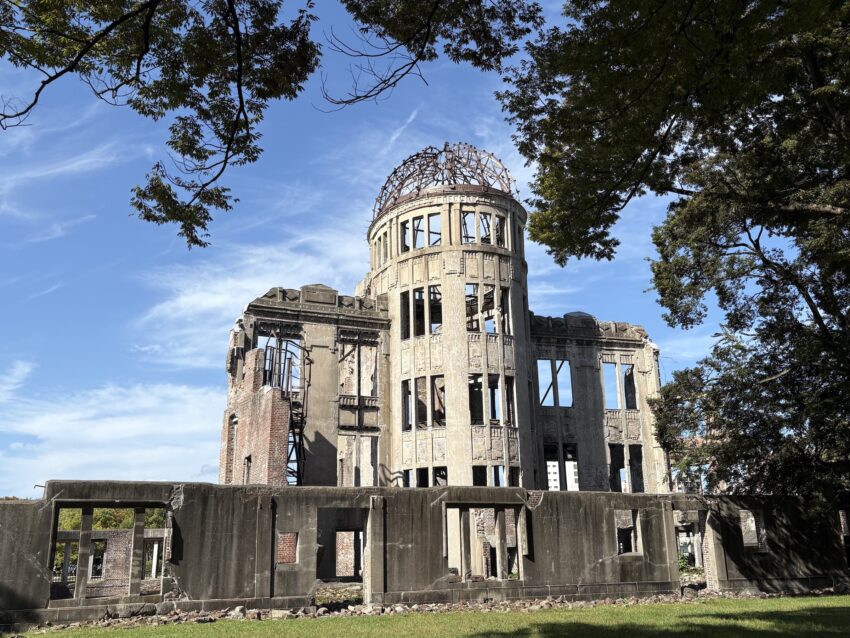
The reason so many of us travel to Hiroshima is obvious – to witness the site where the world’s first atomic bomb was exploded in anger. Around 70,000 people died instantly when it was dropped on 6 August 1945, many thousands more followed in the years after.
On our first night in the city after a four-hour Shinkansen journey from Tokyo, we walked in a slight drizzle to the Peace Dome, a UNESCO World Heritage Site, which stands on the banks of the Ōta River as a lasting testament and memorial to the horrors of that night and its aftermath. The former product exhibition hall somehow survived partially intact despite being so close to the epicentre of the blast, crowned by a twisted metal dome. Rubble remains strewn on the ground around the walls while the modest grounds are shaded by mature trees. It was a haunting site that night in the murk. By day it’s busier, surrounded by tour groups visiting one of the last buildings in Hiroshima that still stands from that time. Around it has grown a new, modern and welcoming city of towers and wide boulevards, with Hiroshima Bay and its cluster of islands to the south.
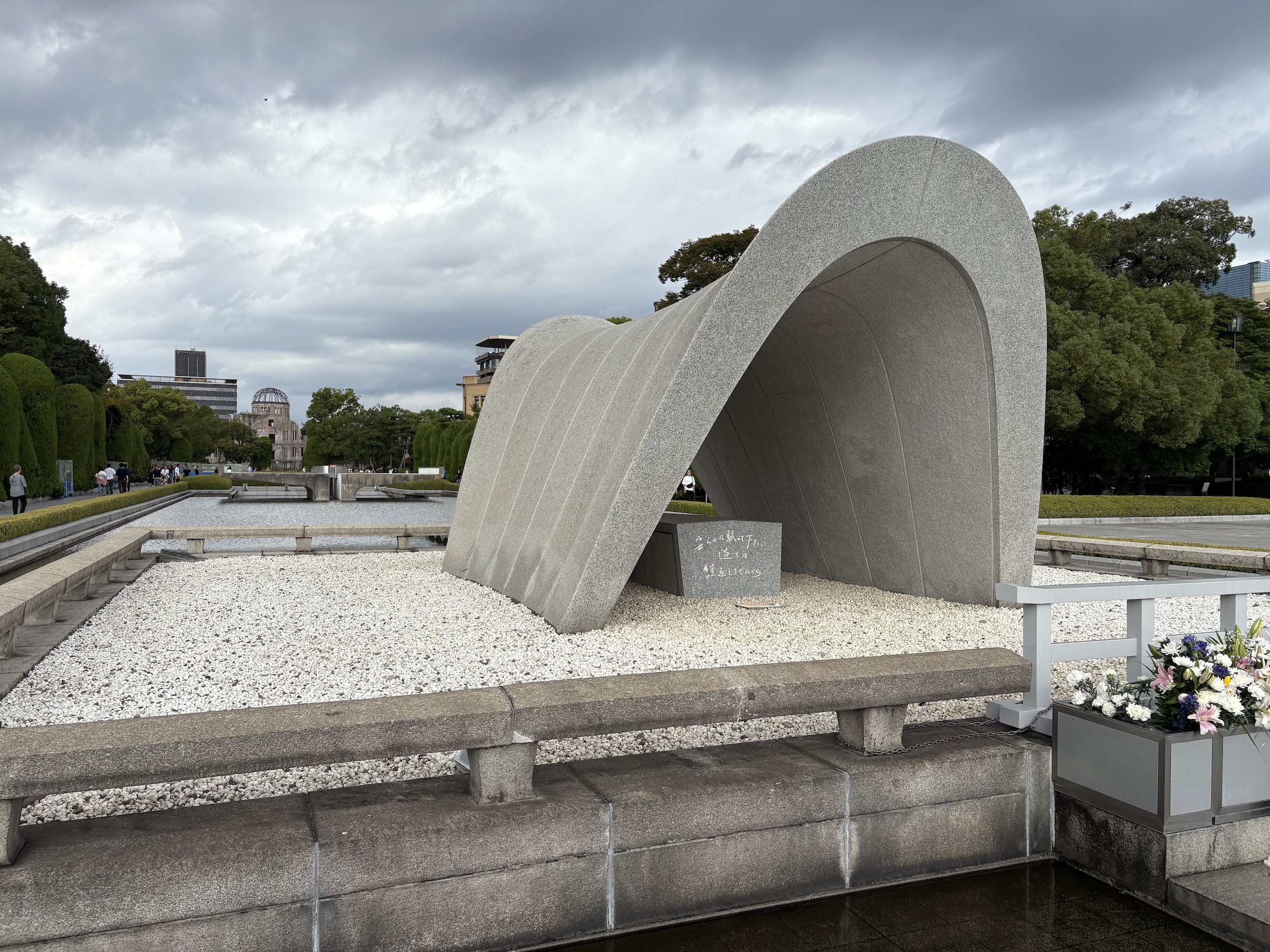
The Dome lies within the Peace Park, which in turn was laid out where the once bustling and mostly wooden Nakajima neighbourhood stood before the war. The river flows by on either side and trees blossom where once was devastation. The park has several memorials and post-war buildings, many of which are design masterpieces. A striking cenotaph aligns with an everlasting flame, which hovers above a shallow reflecting pool, and the dome beyond. And overlooking it is the architecturally magnificent 1950s Peace Memorial Museum designed by Kenzō Tange.
The content of the museum is incredibly moving and often difficult to witness, both in terms of the harrowing content and the sheer numbers of visitors. We were carried along on a wave of humanity, crushed this way and that, and couldn’t see half of what was on show because of it. Many wept at the imagery, the graphic depictions of death and the terrible injuries inflicted on adults and children alike. Nothing was spared. Perhaps the most poignant exhibit featured part of a building that included a vague shadow on a set of steps, all that remained of the person who was incinerated while sitting there at the time of the blast. Overall the museum is a pretty blatant call for peace and the abolition of such terrible weapons, and one can’t help but agree with the sentiment. But as is often the case in Japan, there wasn’t much explanation as to why the allies felt the need to drop the bomb in the first place (and again on Nagasaki a few days later) and slaughter so many innocent civilians. The sheer intransigence of the country’s political leaders and military men and their refusal to surrender despite facing certain defeat was barely touched upon. All the evidence shows that Japan, a country notorious for its often unquestioning respect for authority figures, has still to come to terms fully with its role in the war.
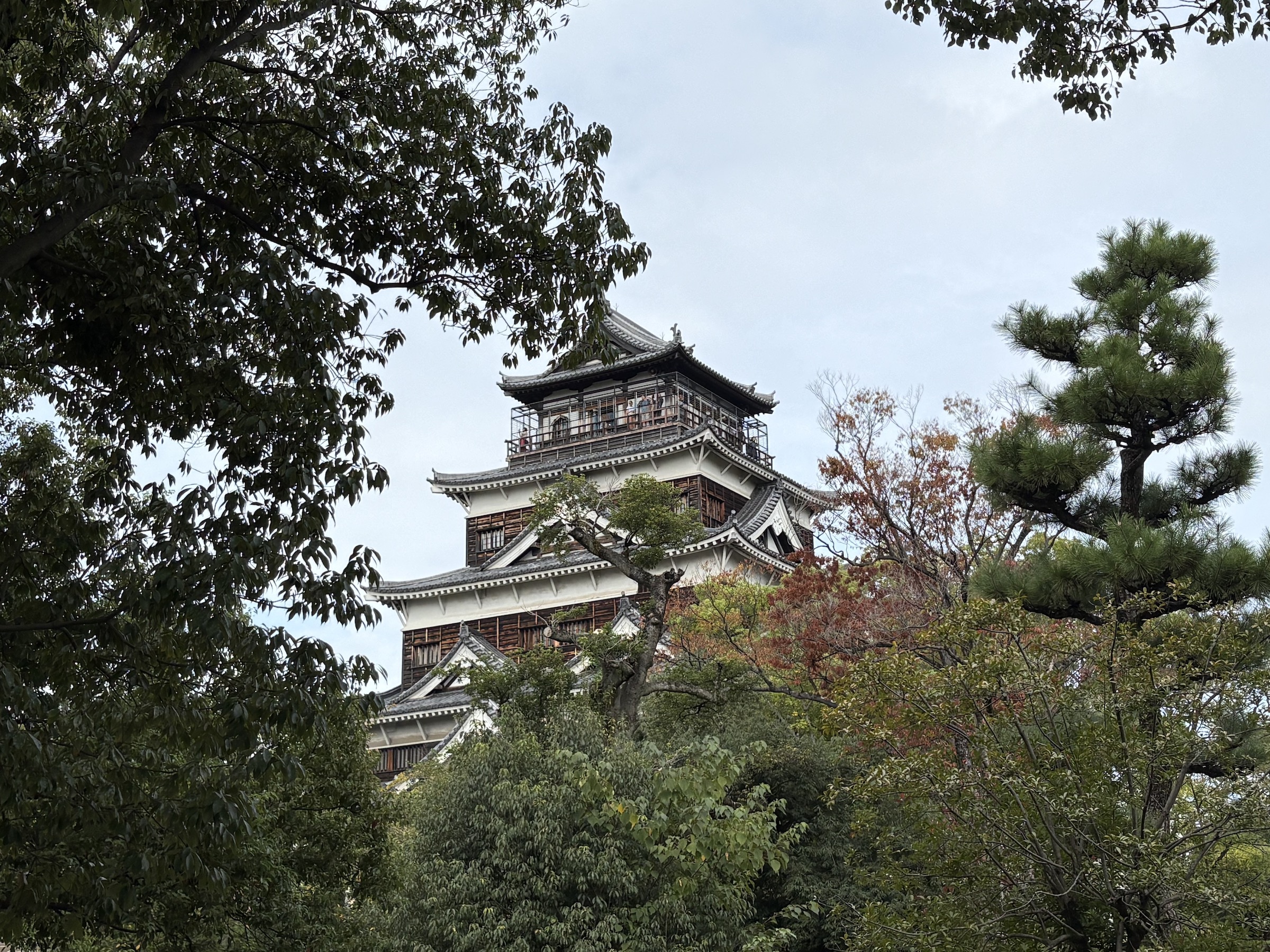
Hiroshima was a significant industrial centre and military base before and during the war, which explains why it was targeted by the bomb planners. The area around Hiroshima Castle – a short walk from the Peace Park – had been one such military facility that was wiped out on 6 August. The castle keep was destroyed but in the years that followed was, like many others in Japan, rebuilt in resemble the original – at least from the outside. That wooden-clad exterior is convincing and handsome, although not as spectactular as Himeji Castle, but the interior is just a concrete shell containing a sometimes diverting history of the city, the castle and its residents. The moated park in which the castle sits is attractive enough, containing remains of a few military structures, a shrine and some other buildings that have been restored sympathetically. Perhaps the most remarkable features are the few trees that still stand as survivors of the nuclear blast, growing happily despite that traumatic shock to their systems.
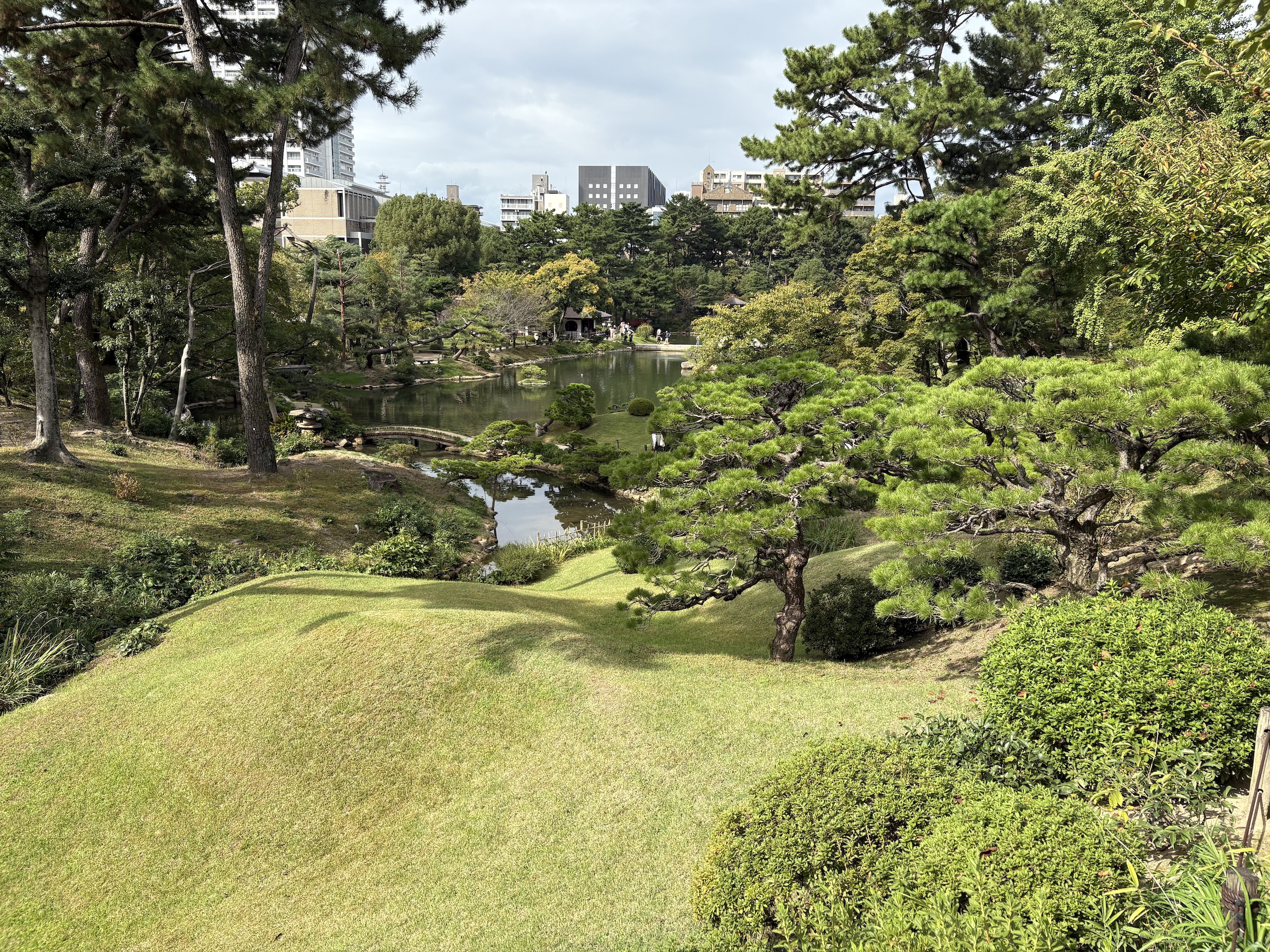
A short walk beyond, on the banks of another branch of the Ōta River, we toured my personal favourite of Hiroshima’s attractions – the Shukkeien landscape garden. Dating from the 17th century, but obviously much restored over the years, it has a central lake and various elements that represent the wider landscape such as hills, mountains, rivers, valleys and forests. A path allowed us to explore, passing tea houses and bamboo groves, modest paddy fields, islands built in the shape of tortoises and cranes and spots where we could feed the koi carp. Bridges of various shapes and sizes crossed the lake and several streams. The attention to detail was superb, as you’d expect in a Japanese garden, with perfectly manicured pines, carefully sculpted shrubs and ideally placed lanterns. I could’ve stopped there for an age.
I liked Hiroshima. Like any Japanese city it was big and busy, but also friendly and quirky – a jazz festival in the park here, a cat cafe there. We ate exceptionally well at modest restaurants, stayed in the giant Crowne Plaza with its great views of the bay from the top floor lounge, and found a craft beer place at Neighborly Brewing in one of the ever-busy central arcades. We took a tour of Miyajima and ate French toast in a busy department store. But then it was time to board the Shinkansen again, bound for Osaka.